Water First North Florida: The $1.1 Billion Project That No One Likes, Except Insiders, Is on the Ropes
Where is it now and how did it get there?
May 15, 2026 9:45 am | 8 min read |
Comment
AI Summary in a minute
 North Florida – The Water First North Florida
Project, a plan to move Jacksonville’s mostly treated
wastewater from the Jacksonville area into the Suwannee
Valley aquifer, is going back to the drawing board,
according to State Senator Corey Simon.
North Florida – The Water First North Florida
Project, a plan to move Jacksonville’s mostly treated
wastewater from the Jacksonville area into the Suwannee
Valley aquifer, is going back to the drawing board,
according to State Senator Corey Simon.
Senator Simon released his letter on his Facebook page at 12:55 pm on May 12.
The Suwannee River Water Management District (SWMD) monthly meeting convened at 9 am and concluded at 11:37 am on the same day. There was no mention of Sen. Simon’s letter during the meeting, which had many speakers objecting to the Water First North Florida Project (WFNF).
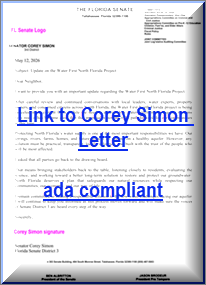 Sen. Simon’s letter spread across North Florida
social media like a field fire on a windy day. The
Senator claimed, among other things: “the Water First
North Florida project is being canceled in its current
form,” and that he “asked that all parties go back to
the drawing board.”
Sen. Simon’s letter spread across North Florida
social media like a field fire on a windy day. The
Senator claimed, among other things: “the Water First
North Florida project is being canceled in its current
form,” and that he “asked that all parties go back to
the drawing board.”
It is unclear when, if, or how the SRWMD received Sen. Simon’s letter. Later in the day, your reporter requested a response from Executive Director Hugh Thomas regarding the “rumor” of the project’s cancellation. The upper management of the District has played it ‘cagey’ about the WFNF project from the beginning, and the District’s response to this request was no exception. Executive Director Hugh Thomas refused a direct answer. All that the district put out was, “The District is aware of the letter. At this time, we do not have additional comment regarding the project. Any additional questions can be directed to Senator Simon’s office.”
Accordingly to Senator Jennifer Bradley's office: after 5 pm yesterday (May 14), the Senate and House conference spread sheets were finally aligned and funding for WFNF was officially removed from this year's Florida budget.
It is also unclear when Representative Brannon received Senator Simon’s news. At 4 pm, your reporter spoke with Representative Brannan’s office, which knew nothing about the letter. Your reporter emailed a copy of the letter to them.
About a half-hour later, your reporter heard from Rep. Brannan. He explained he just got out of a funeral.
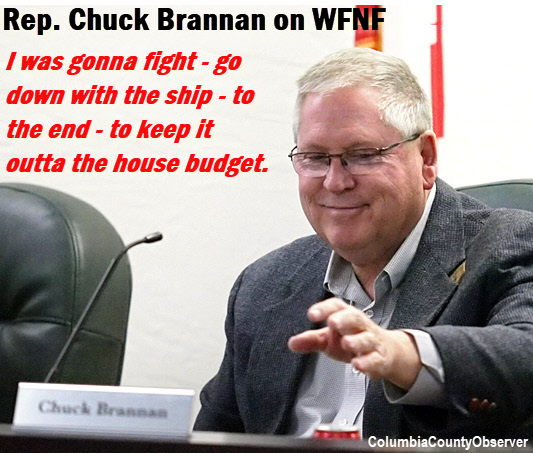
Rep. Brannan said, “You know, I had always fought to keep that North Florida Water First project out of the House of Representatives budget. It has always been at zero, and as of today, still remains at zero in the Florida budget. Just a few minutes ago, the Senate took $20 million out of their budget. They had $20 million seed money in their budget for that project, and they just removed it.”
Rep. Brannon mentioned that the project was killed for this year, adding, “I was gonna fight – go down with the ship – fight to the end to keep it outta the house budget where it's always been at zero.”
Rep. Brannan was not easy on the Water Management Districts (WMDs), Suwannee and St. Johns, and the Florida Department of Environmental Protection. He said, “That thing has always been driven by the water management districts…cooked up by them…with the Florida Department of Environmental Protection.”
Representative Brannan also took exception to the lack of communication between the WMDs and the legislature. “I was aggravated that the water management districts had never come to the legislature…They certainly didn’t talk to representatives in this area about it, that I know.”
He added, “It ain't over till the fat lady sings, and the budget probably won't be done officially ‘till another week or so, but right now it's zero money in the House and zero in the Senate.”
Finally, Rep. Brannon said, “It [the project] was below the radar…the WMD’s, they act like they didn’t know anything about it, but they were complicit in it.”
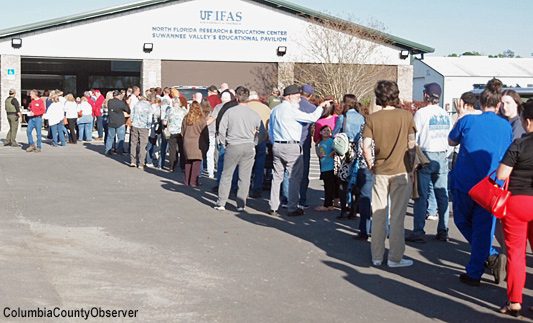
On March 19, 2026, the line of discontent of people
waiting to see what the District had to offer on the
WFNF project was long. The comment cards content
received by the District was never revealed.
Complicit – You Bet
SRWMD: October 14, 2025 – The cat begins coming out of
the bag
While both the SRWMD and the SJWMD had been discussing the Water First North Florida project for years, although it may not have had an official name, the low-flying plan was coming together in 2025. The first mention [in the District’s non-ADA-compliant minutes] of the Water First North Florida Project was during the October 14, 2025, meeting. The District referred to it as the Water First Project.
By the time the conversation was brought up, no members of the public were present, and if any had been, no one would have known what was being discussed. The WMD Board appeared clueless about the cost, which was made clear by Board Chairwoman Virginia Johns, who asked, “I've got a question on our Water First Project. Obviously, it's going to be very expensive. Can you give us an idea [of] the support, that financial support, that might be – I mean – has Tallahassee – do they like the project? Are they supporting this…are we – we're beginning to have those conversations with our legislators?”
Executive Director Hugh Thomas answered, “I'll be having some of those conversations this afternoon and then next week. But we are working cooperatively from the state side with the DEP and then St. Johns [River WMD] and myself, the District here, to have those conversations…also with our communities to make people aware of that project.”
Board member Larry Thompson asked, “That project's like 50 MGD, isn't it?”
Director Thomas responded, “The Water First Project. Right now, I believe it's slated at 40 MGD, Mr. Thompson, but there is potential for it to grow…because there are other utilities…that have already inquired about participating in that project, and that would add to the resource available.”
After almost two hours, the meeting adjourned.
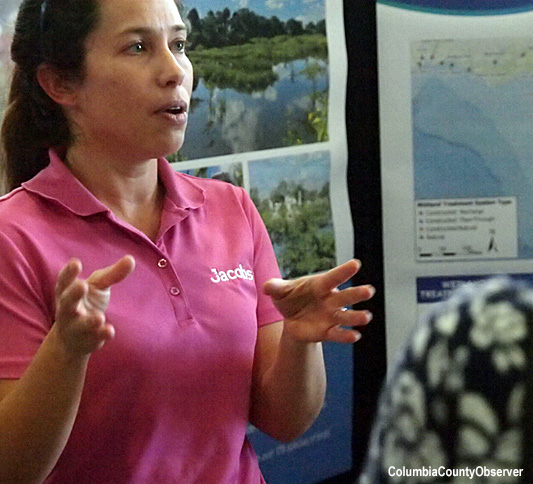
Jacob’s Engineering showed up en-mass for the community
meeting. Jacobs stands a lot to lose if the pipe goes
down. Most attendees didn’t realize that they were
talking to contract engineers.
The $1.1 Billion Pipe
SRWMD: Nov. 12, 2025. On the record, “under the radar,” and with not one word on its agenda, the SRWMD was about to be all-in on the estimated $1.1 Billion Water First North Florida project.
The agenda for the Nov. 12, 2025, SRWMD board meeting had not one word about the Water First North Florida Project. The project was to pipe 40M gallons a day of mostly treated Jacksonville wastewater to the Suwannee River Basin through a big pipe.
A thorough review of the supporting materials showed that the project now had a proper official name: Water First North Florida.”
The supporting information also showed that the SRWMD’s communications and outreach team, Katlyn Potter and Troy Roberts, met in Tallahassee in early September with the Moore Agency, a public relations firm, to discuss the WFNF project. Yet, the “Water First North Florida” project appeared in the SRWMD 2025 minutes only once, in November 2025.
Despite WFNF being the most substantive policy item discussed during the meeting (occupying 30+ minutes of board time and public comments from two public utility directors, and a unanimous vote committing the District to a multi-decade $100M+ regional recovery strategy), the WMD minutes of the November 2025 board meeting failed to mention the Water First North Florida project.
At this time, the public was generally unaware of the Water First North Florida Project, and only two people showed up to make public comments: Jeremy Johnston, Executive Director of the Clay County Utility Authority and Rick Hutton Hutton, Exec. Dir. of GRU, both of whom were interested in adding their own treated wastewater to the Suwannee Basin.
Mr. Johnston formally offered CCUA's support for the strategy, noting the rigorous professional analysis that went into identifying this project out of 800 options. (Nobody knows where those 800 options are). He stressed the long-term value it will bring to their customers and the environment.
Mr. Johnston told the board, “The rigorous analysis completed to date shows the Water First North Florida project as the best, most comprehensive approach to sustainably addressing the MFL…” (MFL=Minimum Flows and Levels)
Mr. Johnston, the darling of the fledgling North Florida Water Utility Authority (the woe begotten Columbia/Suwannee utility collaboration), is in favor of pumping CCUA wastewater into the Suwannee River Basin, something both Columbia and Suwannee Counties have unanimously officially protested.
All the Board members and the SRWMD staff who spoke about the WFNF project were 100% behind it.
Executive Director Hugh Thomas gave his take by highlighting the project’s resilience against climate limitations, pointing out that because the project relies on reclaimed water, it remains viable even during severe droughts.
(People don’t stop flushing their toilets).
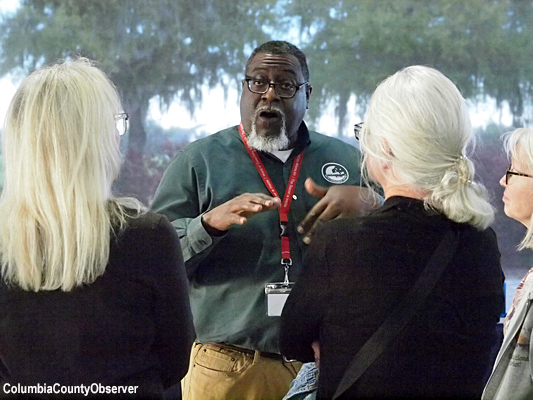
Chief SRWMD Engineer Leroy Marshall explains the WFNF
project to three doubters at the community meeting.
He said, “The good thing I really like about this project is, in times like this… this would be a consistent source of water.”
Dr. Amy Brown (hydrogeologist), Deputy Executive Director of Water Resources, explained, "Water First North Florida rose to the top of the list because it addressed the full recovery and prevention needs of the region at both the Santa Fe and Ichetucknee, and the capital cost was less than the desalination options."
Dr. Brown addressed the funding options: "The key step is the approval of these three documents... [2025 Implementation Strategy for the Lower Santa Fe and Ichetucknee Rivers and Priority Springs, the Recovery Strategy, the Update to the N. FL Regional Supply Plan] that puts these projects into a recovery strategy benefiting an outstanding Florida spring, and it allows some of the cooperators to pivot towards directly funding this project... even in advance of the rule being considered before the legislature."
Board member Larry Thompson said, “This is a legacy project—it will outlive us all, but today is a milestone."
Board member Richard Schwab said, “Serious solutions require regional projects like WFNFP. It balances growth and resource protection without detriment to rural economies.”
Board member Charlie Keith said, referencing the Jacobs Engineering $2.1M citing study, “The citing study must optimize costs for multi-site recharge."
With the public and the legislators in the dark, the project rolled through without a hitch.
SRWMD Hits the WFNF Promotion Trail: It was not pretty
John Quarterman, WWALS Watershed Coalition (WWALS), the Suwannee Riverkeeper, began beating the drum, shaking the trees, and informing the River people that if the Water Management Districts had their way, 40 Million Gallons a Day of Jacksonville’s processed wastewater (not drinking quality water) would be pumped into the Suwannee River Basin.
Wherever the WMD promoted the WFNF project, they were met with derision and protests. The WMD management, now on the record of being in full support, didn’t want to answer questions and hightailed it out of meetings. People began showing up at WMD meetings and speaking out.
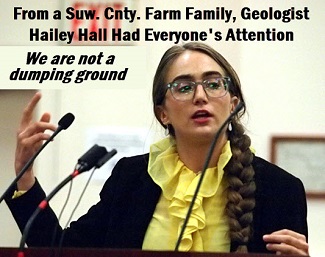 Local
governments and residents alike were unhappy. See:
Water First North Florida Makes Its First Columbia
County Appearance – It Was a Tough Sell for the SRWMD –
No One Was Buying
Local
governments and residents alike were unhappy. See:
Water First North Florida Makes Its First Columbia
County Appearance – It Was a Tough Sell for the SRWMD –
No One Was Buying
All the Counties in North Central Florida passed resolutions opposing the project.
On March 19, 2026, the SRWMD held what it called a “Community Meeting” at the UF/I FAS center outside of Live Oak. It was a bust for the District, and they had nowhere to go. The public outrage was calm, but palpable. It is unknown if the District got the message. People had to line up and fill out a comment card to enter. Those cards and the comments were never revealed by the WMD.
Where Are We Now?
“It ain’t over till the fat lady sings.”
Folks have had a chance to digest the Senator Simon Letter, and the remarks by Representative Brannon.
Accordingly to Senator Jennifer Bradley's office: after 5 pm yesterday (May 14), the Senate and House conference spread sheets were finally aligned and funding for WFNF was officially removed from this year's Florida budget.
While the funding was removed by the legislature, the project does not automatically go away – only the funding.
The legislature's $0 appropriation only zeroes out the state's direct contribution. Other funding sources remain intact for now:
The JEA Board:$400 million approved in November 2025
St. Johns River Water Management District: $100–125 million committed
Total district/JEA commitments: roughly $1.1 billion project cost
The legislature does not directly control those existing district/utility budgets.
As Representative Brannan said, “It ain’t over till the fat lady sings.”
Comment
On May 15, 2026, Richard Leonard from Gilchrist County wrote:
I fully support NCFRPC’s
efforts to scrap this plan. Those in the Jacksonville
area are simply making their problems ours.
I originally bought my property in Gilchrist County
specifically for the beautiful springs in the area and
clean water, which in the future will be invaluable to
those living in the areas represented by NCFRPC. To
recognize the danger of the JAX Proposal, all one has to
do is take a trip down the Turnpike to see the
overbuilding going on north of Orlando and mentally
project the ultimate dangers to our Florida environment
this overbuilding will have on our environmental
resources.
We can’t let the Tallahassee politicians give away our
Springs. The fight is just beginning.