Water First North Florida Makes Its First Columbia County Appearance – It Was a Tough Sell for the SRWMD – No One Was Buying
February 21, 2026 7:30 pm | 8 min read |
Comments
AI Summary
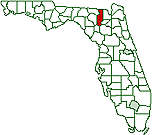
Columbia County Observer photo and
graphic.
 COLUMBIA COUNTY, FL – Water First North Florida made
its first Columbia County appearance. It was a tough
sell for the Suwannee River Water Management District –
No one was buying.
COLUMBIA COUNTY, FL – Water First North Florida made
its first Columbia County appearance. It was a tough
sell for the Suwannee River Water Management District –
No one was buying.
Forever chemicals, PFAS, poop, pee, drugs, heavy metals, and more need to be kept from entering the aquifer (where your water comes from). Drought, falling water levels, and development are drying up the springs. What to do?
The Suwannee River Water Management District (SRWMD) has a solution: Water First North Florida. Many residents in North Florida don’t think the solution is a good idea.
Money is not the problem. It's the thinking that's the problem.
Columbia County 5 Chairman Tim Murphy
The SRWMD has been on the road promoting the Water First solution: building a pipeline from Jacksonville (St. Johns River Water Management District) and pumping Jacksonville’s treated wastewater (folks are questioning the level of treatment and its safety) and pumping 40 million gallons a day to the Suwannee River Water Management District to recharge the aquifer.
On Thursday evening, the County 5 (Board of County Commissioners) hosted the SRWMD top staff to present its Water First North Florida plan.
The word got out, and the public came out to see the presentation and comment.
Water Management District presents Water First
WMD Executive Director Hugh Thomas and Deputy Executive Director, Water Resources, Amy Brown, Ph.D., presented on behalf of the WMD.
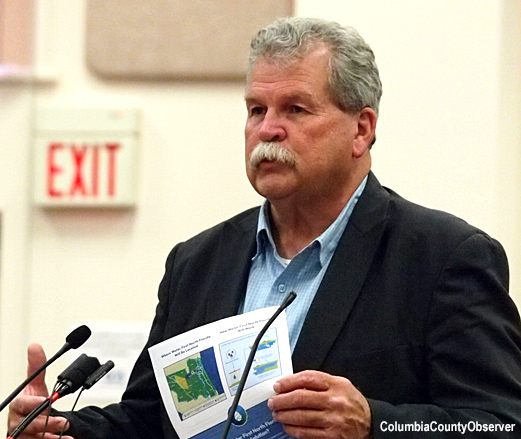
SRWMD Ex. Dir. Hugh Thomas introduces the County 5 and
the audience to
Water First and Dr. Amy Brown.
Director Thomas introduced the proposed Water First project: "We want to start getting out... trying to dispel misinformation and put factual information out there about the status of this project and the intent of this project."
Dr. Brown took over, did the heavy lifting, and presented the proposed project.
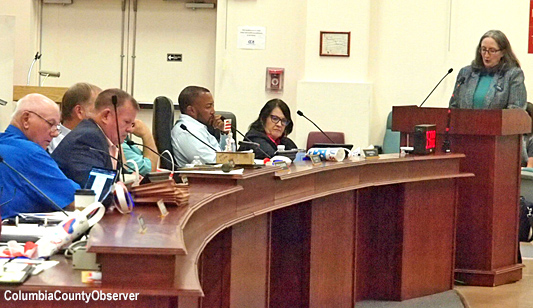
Dr. Amy Brown presents Water First to the Columbia
County 5 and the attendees.
Dr. Brown explained that the SRWMD and St. Johns River WMD (SJRWMD) have jointly planned regional water supply since 2008 because withdrawals in one district affect natural systems in the other.
Recovery/minimum flows plans were updated and approved by both boards in November. If no project is implemented, SRWMD projects about a 30% across-the-board reduction in allocations for existing users to achieve recovery.
Dr. Brown said reclaimed water from the East Coast, treated with advanced processes and wetlands, was the most cost‑effective and technically feasible of hundreds of options reviewed. Keeping JEA’s reclaimed water solely on the east coast (in Jacksonville) would not recover the Ichetucknee; recharge must occur closer to the affected springs to yield measurable benefit.
JEA (formerly Jacksonville Electric Authority) is the largest municipal electric utility in Florida and an essential provider of water and sewer services to over 1 million residents in Jacksonville and parts of three adjacent counties. As a not-for-profit, community-owned entity established in 1895, it operates independently to provide electric, water, wastewater, and reclaimed water services. (Gemini)
If nothing is done, SRWMD projects about a 30% across‑the‑board cut for existing users (cities, mining, agriculture).
Dr. Brown explained that the core concept of the project is to pipe about 40 million gallons a day (mgd) of highly treated reclaimed water from the east coast (Jacksonville), add advanced pretreatment, then use the water for aquifer recharge over here to support springs and rivers by using spray fields and natural filtration to get the water back into the aquifer (recharge).
The WMD claims the project includes the capability to retain and recharge water within SJRWMD when SRWMD is wet or if water quality needs further polishing; only water meeting the required quality would be conveyed west.
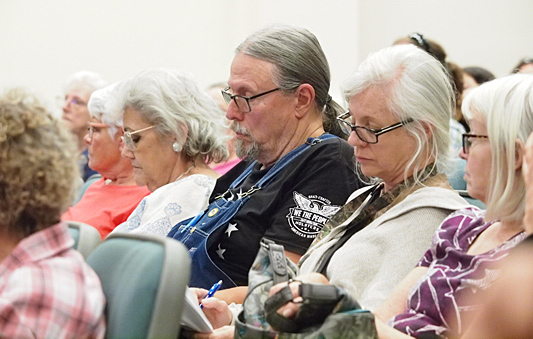
Moses Clepper came from Suwannee County to address the
PFAS chemicals remaining in
the soil. (Columbia County Observer photo)
Dr. Brown mentioned that there is ongoing science: A JEA Buckman Plant pilot is testing pretreatment and wetland designs to address emerging contaminants (including PFAS) and nutrients (nitrate).
Alternatives to the pipe were evaluated. Desalination was found to be far more expensive and energy-intensive, while applying similar advanced treatment to reclaimed water is more cost-effective because it contains fewer dissolved constituents than seawater.
Dr. Brown explained that large-scale direct withdrawals from the Suwannee River were evaluated among hundreds of options, but are generally only possible during flood conditions and offered less benefit-cost effectiveness than Water First.
Finally, while not part of Dr. Brown’s presentation, Florida SB 64 came up during the Water First town hall at The 5. SB 64, which has been in effect since June of 2021, eliminates the discharge of effluent, reclaimed, or reuse water by surface water discharge, except for beneficial uses, by January 1, 2032.
Surface water discharge in Florida refers to the release of treated wastewater or stormwater runoff directly into surface water bodies—such as lakes, rivers, streams, or wetlands—rather than into the ground. It is highly regulated, requiring permits to manage pollutants, and is increasingly being phased out under state law to promote water reuse. (FDEP)
The WMD needs to update its understanding and explanation of SB 64, which is a driving force in North Florida’s water issues.
Important quotes from Dr. Amy Brown and Ex. Dir. Thomas
"We need to jointly plan for the future, because the water use in one district impacts the natural systems in the other." — Amy Brown, SRWMD
"Water conservation is a huge piece of what we're looking at for this area... we can make a substantial difference in our water supply demands if we implement [it] fully across all different use types." — Amy Brown, SRWMD
"The fact that every individual permittee has to solve the problem independently is infeasible for many of our existing legal users of water, including the farmers... and our small municipalities." — Amy Brown, SRWMD
"The collaborative effort... was kind of the template... if they collaborated on one solution that addressed the problem, that became a more efficient way to recover the system." — Amy Brown, SRWMD
"Treatment wetlands themselves can be recreational amenities... [with] environmental cleanup benefits." — Amy Brown, SRWMD
"There is work going on right now... to understand, characterize, and be able to treat effectively [emerging contaminants in reclaimed water]." — Amy Brown, SRWMD
"Desalination [is] much more expensive... you're looking at an energy cost, a disposal cost, and then also just the cost of the processes themselves." — Amy Brown, SRWMD
"The ability to bring [treated water] to the west and recharge it locally is what would allow us to recover the system." — Amy Brown, SRWMD
"If you don't do this project, then you have to either reduce allocation or put online an alternative project... [which] would be a 30% reduction in use across the board." — Amy Brown, SRWMD
“The water quality for the Water First project would far exceed what’s being discharged today. It will exceed what is occurring right here at the Lake City wastewater treatment plant site.” — Hugh Thomas, SRWMD
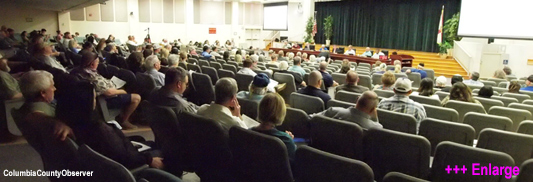
Folk came from surrounding counties to participate in
what became a town hall.
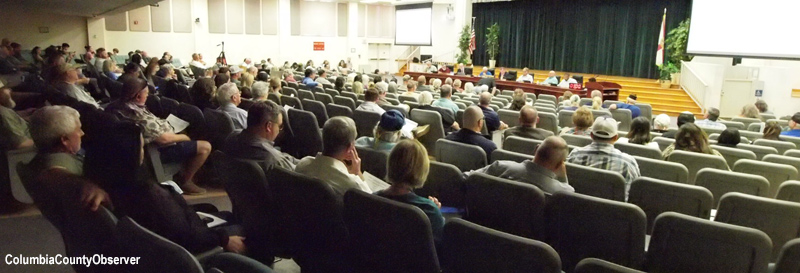
Residents and Local Officials Speak Out: Counterpoint Positions
The public's and the County 5's responses were overwhelmingly negative, characterized by skepticism about safety, fairness, and the motives behind the project. People came to The 5’s Town Hall-style presentation from the counties surrounding Columbia to make themselves heard.
Contamination Fears: The primary concern was the introduction of "toilet water" into the aquifer. Speakers cited fears of "forever chemicals" (PFAs), pharmaceuticals, hormones, and nitrates contaminating the local water supply. Several speakers, including Moses Clepper, cited data on existing PFA levels in springs and argued that current treatment technology cannot fully remove these contaminants.
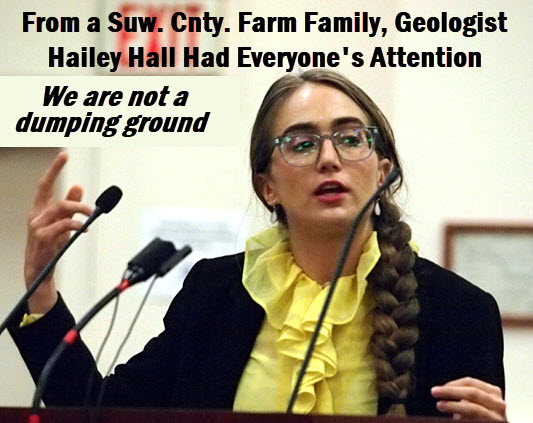
Environmental Justice – “We Are Not Dumping Ground": Residents expressed anger that rural counties were being used as a disposal site for Jacksonville's waste. County 5 members and the public argued that Jacksonville is prioritizing its own urban expansion and cost savings over the health and economic stability of rural communities.
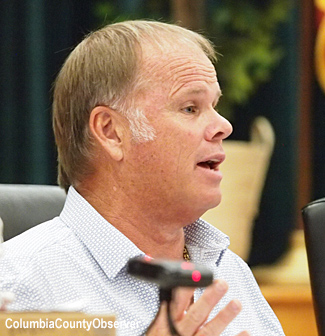 Desalination
vs. Reclamation: County 5 member Robbie
Hollingsworth challenged the WMD’s dismissal of
desalination. He argued that JEA should invest in
desalination plants to solve its own supply issues
rather than transporting waste inland. He questioned the
cost estimates provided by the WMD, suggesting the
environmental cost to the aquifer outweighs the
financial cost of desalination.
Desalination
vs. Reclamation: County 5 member Robbie
Hollingsworth challenged the WMD’s dismissal of
desalination. He argued that JEA should invest in
desalination plants to solve its own supply issues
rather than transporting waste inland. He questioned the
cost estimates provided by the WMD, suggesting the
environmental cost to the aquifer outweighs the
financial cost of desalination.
Root Cause and Accountability: Nathaniel Warner argued aquifer depletion is caused by population growth in other regions, not in Columbia County, and questioned who bears legal and financial liability if contamination occurs. Dee Paddock referenced historical broken promises (Occidental Chemical drying up local springs) and questioned who would monitor the project long-term.
Lack of Local Control: There was frustration over the perceived lack of local authority to stop the project, with residents feeling the decision was being made at the state level.
Skepticism of Science: While Dr. John Roe (identified only as a researcher) attempted to assure the crowd that treatment wetlands could effectively break down contaminants, the crowd remained unconvinced. Commissioners and residents emphasized that they did not want the "risk" associated with the project, regardless of the science presented.
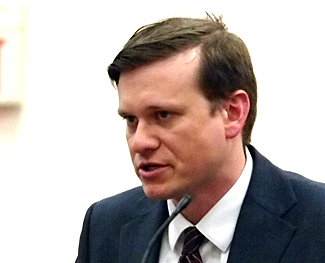 Legislative
Status: County lobbyist Staz Guntek reported
that the project has only a $20 million Senate budget
line item and one ratification bill (passed one of three
committee stops), noting, “there isnothing on the House
side— no budget item, no bill,” adding, there is "no
guarantee" of legislative action this session.
Legislative
Status: County lobbyist Staz Guntek reported
that the project has only a $20 million Senate budget
line item and one ratification bill (passed one of three
committee stops), noting, “there isnothing on the House
side— no budget item, no bill,” adding, there is "no
guarantee" of legislative action this session.
Important Quotes from the Public and The Columbia County 5
"We didn't have no hurricanes last year... We didn't have nothing bringing in [water]. We're still living. I don't want to eat, drink, sleep, or swim in my toilet, and I for sure don't [want] Jacksonville's." —Bruce Dicks, Columbia County
"It's not just about the volume of water. It's also about how clean the water is. I don't care how much water you put back if it's filled with birth control, hormones, and all sorts of crap."
"What I heard in that video was not 'this treatment plant can get the hormones out and get the PFAs out.' I heard, 'We're researching it. We don't know what it can even do yet.' You don't even know what you're going to be putting into the ground." —Hailey Hall, Suwannee County
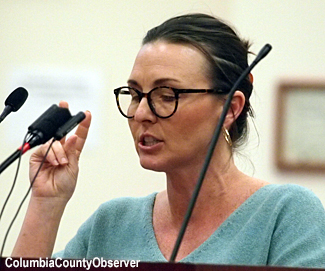
"We were chosen because it's cheaper, easier, and shifts long-term risk from Jacksonville to us. They literally prioritized city growth over our health, our land, and our river systems." —Josie Gaskins, Columbia County
"Jacksonville just spent 925 million for a football team... if Jacksonville will do a 50 or $100 million [desalination] plant and let that aquifer fill itself back up, I think it'd be a better plan." — Robbie Hollingsworth, Member of The 5
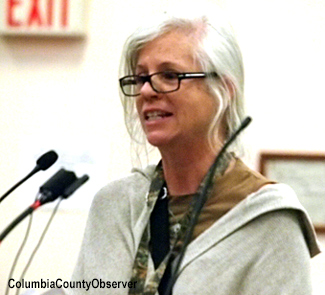
"They have renamed the treated wastewater as 'reclaimed water' in order to make it more acceptable to those who are not paying close attention." — Carol Eckhert, Suwannee County
"Did you know that JEA is under consent order right now?... That means that they're polluting the St. Johns River every day." — Merrilee Malwitz Jipson, Columbia County
 “I
have seen things like Occidental come in. I don't know
where they were. When Occidental came in, they promised
they would not take enough water out to ruin the springs
and so forth. They did… I suggest tonight you call
DeSantis, [and] your representative.” — Dee Paddock,
Suwannee County
“I
have seen things like Occidental come in. I don't know
where they were. When Occidental came in, they promised
they would not take enough water out to ruin the springs
and so forth. They did… I suggest tonight you call
DeSantis, [and] your representative.” — Dee Paddock,
Suwannee County
"We don't solve resource depletion by introducing new risks into the system. We solve it through responsible management, transparency, and protection of the resource itself." —Nathaniel Warner, Columbia County
“The people have spoken. We don’t want a big septic tank for Jacksonville’s waste.” —Kevin Parnell, Member of the 5.
Epilogue
After the meeting, your reporter reached out to WMD Executive Director Hugh Thomas for a final thought. His response:
“The work for Water First North Florida is ongoing, and the research continues. The Suwannee Valley needs water to recharge our springs and rivers and sustain our farms and small businesses. No matter what water comes into our area, it will have to meet drinking water standards.”
“We hear the concerns of our residents and are taking note. We will continue to evaluate every option.”