Water First North Florida – The Plan to Pipe Jacksonville’s Wastewater To the Suwannee River Basin – Another Thumbs Down
March 28, 2026 6:15 pm | 6 min read
AI Summary in a minute
Photo: Getty Images via Unsplash
 COLUMBIA COUNTY, FL – Thursday night, Water First
North Florida, the plan to send 40 million gallons a day
of Jacksonville’s mostly treated wastewater into the
Suwannee Basin, got the unanimous thumbs-down from the
North Central Florida Regional Planning Council.
COLUMBIA COUNTY, FL – Thursday night, Water First
North Florida, the plan to send 40 million gallons a day
of Jacksonville’s mostly treated wastewater into the
Suwannee Basin, got the unanimous thumbs-down from the
North Central Florida Regional Planning Council.
The North Central Florida Regional Planning Council (NCFRPC) is 12 counties in North Central Florida: Alachua, Bradford, Columbia, Dixie, Gilchrist, Hamilton, Lafayette, Levy, Madison, Suwannee, Taylor, and Union, and many small towns and cities.
The Executive Committee
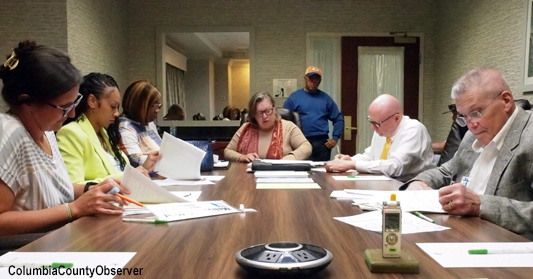
The Executive meets on March 26, 2026.
Major items at the Planning Council run through the Executive Committee, which, an hour before the Council meeting, met to approve the “thumbs-down” resolution against Water First North Florida (WFNF).
The Executive Committee saw citizen visitors for the first time in years. They were there to comment on the anti-WFNF resolution.
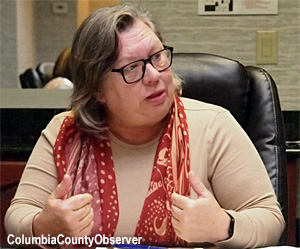 Council
Chairwoman Mary Alford, an Alachua County Commissioner,
said, “We have many, many things in place to conserve
water, and I don't see those same efforts being made in
Jacksonville. If you use less water, then less comes out
the other end of the pipe. And so, I just, I feel like
that is, that's a point that I would like to make in the
resolution, but I don't oppose this resolution.”
Council
Chairwoman Mary Alford, an Alachua County Commissioner,
said, “We have many, many things in place to conserve
water, and I don't see those same efforts being made in
Jacksonville. If you use less water, then less comes out
the other end of the pipe. And so, I just, I feel like
that is, that's a point that I would like to make in the
resolution, but I don't oppose this resolution.”
It is unclear who wrote the resolution or whether any of the Council members provided input.
 Ms. Alford continued, “There are people that think
this isn't a bad idea if it wasn't wastewater. I'm an
environmental engineer. I did my master's research on
wastewater treatment of industrial waste, and
Jacksonville wastewater is full of industrial waste. I
feel like they're asking us to make a commitment without
even giving us all the information. We don't even know
the level of treatment that we're going to be seeing.
They're talking about removal of nitrates. They're not
talking about removal of PFAs or pharmaceuticals or
other industrial waste we haven't even identified yet.”
Ms. Alford continued, “There are people that think
this isn't a bad idea if it wasn't wastewater. I'm an
environmental engineer. I did my master's research on
wastewater treatment of industrial waste, and
Jacksonville wastewater is full of industrial waste. I
feel like they're asking us to make a commitment without
even giving us all the information. We don't even know
the level of treatment that we're going to be seeing.
They're talking about removal of nitrates. They're not
talking about removal of PFAs or pharmaceuticals or
other industrial waste we haven't even identified yet.”
Union County Commissioner Melissa McNeal had reservations because there weren’t conversations with the opposing side. She said, “I feel like to get a fully informed or make a fully informed decision, that you need to have information from both sides. So that's my only reservation when it comes to resolutions, just to make sure that there are informed decisions.”
Archer Town Councilman Fletcher Hope questioned the $1.1 billion anticipated cost of the project as being too low, adding, “It’s your baby, not ours.”
 Suwannee
County resident Moses Clepper commented on the
resolution. He wanted to know the percentage of toxins
that would be piped into the region. He said, “It’s just
a horribly bad idea. We don’t need their toxic water.
Please vote for this resolution.”
Suwannee
County resident Moses Clepper commented on the
resolution. He wanted to know the percentage of toxins
that would be piped into the region. He said, “It’s just
a horribly bad idea. We don’t need their toxic water.
Please vote for this resolution.”
The Executive Committee unanimously passed the resolution to the Planning Council for approval.
The Planning Council
At 7 pm, the Planning Council meeting came to order. It rolled through its agenda, coming to the anti-Water First North Florida resolution.
Chairwoman Alford introduced the resolution, asked the speakers to stick to the 3-minute time limit – “I know that's hard to do sometimes, but we want to give everybody a chance to talk” – and introduced the first speaker, Columbia County resident Layne Schultetus.
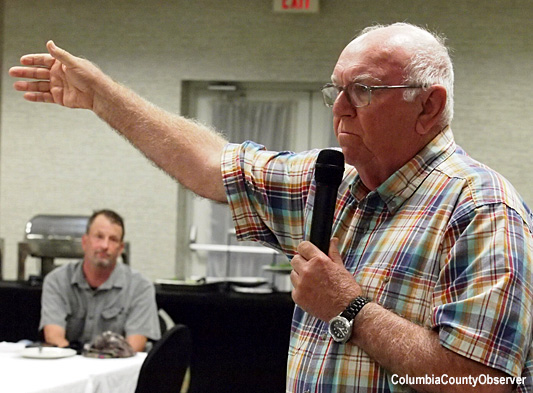
Layne Schultetus, an expert in environmental crimes,
addressed the Council.
Mr. Schultetus introduced himself as a retired environmental crimes investigator with 42 years of law enforcement experience. He strongly opposed the WFNF project to extract and transport wastewater from Jacksonville to the Suwannee basin.
Drawing from his experience and attendance at recent meetings (including the SRWMD’s Community Meeting and county commission meetings), he criticized the project's feasibility, citing past failures in Florida, inadequate water quality data, and environmental concerns like desalination waste. He advocated for alternatives, such as building desalination plants (as in West Palm Beach and Tampa), and prioritized using local water for agriculture over industrial or urban uses in Jacksonville.
Mr. Schultetus praised the Council for passing a resolution against the project. He said, “I am completely against this, and I applaud this board. I applaud you from the bottom of my heart that you have passed this resolution. I hope every county commission, every civic commission within this planning area will also pass resolutions and tell the state of Florida — No.”
Mr. Schultetus’s core motivation was existential, rather than just political. "When 75% of their water use over there is industrial and or flushing toilets, and ours over here in this area is agriculture… I'd rather raise food, okay, with our water, and have nice clean food, nice clean water."
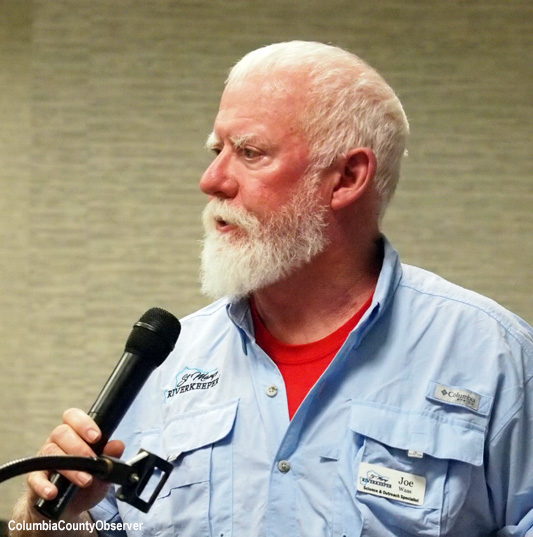
Joe Waas, Science and Outreach Specialist for the St.
Marys River Keeper, learned about the "general feel" of
the Suwannee Basin officials.
Joe Waas is part of the St. Marys Riverkeeper team in Georgia. He said, “I came down here from St Mary's River Keeper just to kind of see what the general feel was down here, so I can report back to our corner of the state. So, thank you for addressing this.”
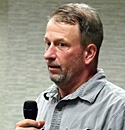 Christopher
Sweeny made a repeat performance from his
last appearance before the Council,
bringing new information. He said he spoke with State
Senator Cory Simon, who told him, “Nothing is final.”
Mr. Sweeny said he was in favor of using desalination to
replenish the aquifer and was against transferring JEA’s
wastewater to the Suwannee Basin.
Christopher
Sweeny made a repeat performance from his
last appearance before the Council,
bringing new information. He said he spoke with State
Senator Cory Simon, who told him, “Nothing is final.”
Mr. Sweeny said he was in favor of using desalination to
replenish the aquifer and was against transferring JEA’s
wastewater to the Suwannee Basin.
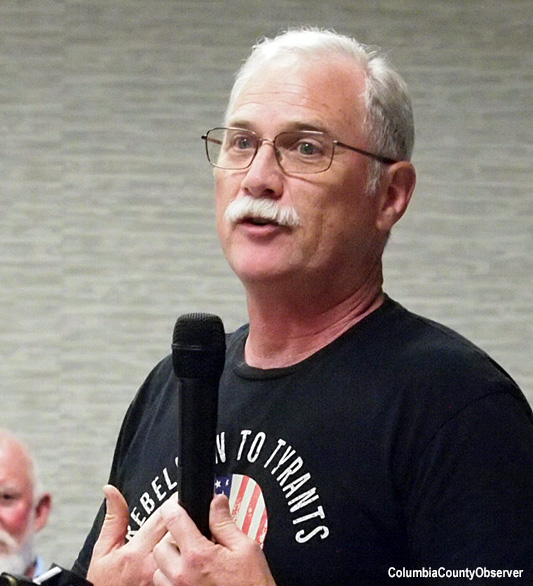
Barry Waldron came from Nassau County to voice his
opposition to the WFNF plan.
Barry Waldron came from Bryceville in Nassau County to speak against the WFNF project.
Mr. Waldron expressed strong concerns about a project to inject treated sewage or wastewater into the local aquifer, which would affect millions reliant on deep wells. Mr. Waldron also had concerns about the lack of transparency, saying that he recently found out about the WFNF project, claiming, “They've kept this pretty much under the wrap” and not widely known.
Mr. Waldron urged greater public awareness via social media and other channels.
The
next public commenter of the evening was Moses Clepper
of Suwannee County. Mr. Clepper has been doing the
rounds of meetings that concern the WFNF project,
appearing in opposition. “This is my sixth, seventh
meeting that I've attended with this. I'm very concerned
that what I've gathered so far is that the JEA and St.
Johns River [Water Management District], with Mr. Rob
Bradley, is really pushing this. And I question the
conflict with Senator Jennifer Bradley being involved
with it, too.”
Rob Bradly is former Florida Senator Rob Bradley. When Sen. Rob Bradley's term limited out of the Florida Senate, his wife, Jeffifer Bradley, ran for the vacated seat and won. Rob Bradley was appointed to the St. Johns River Water Management board by Governor DeSantis in 2020. The position is unpaid.
Mr. Clepper characterized the SRWMD board as “common folks,” adding, “They don’t like the idea, either… They voted [on phase] one unanimously because they got sold a bill of goods.” It is unclear how Mr. Clepper arrived at his "sold a bill of goods" conclusion.
Mr. Clepper concluded by telling the Council, “We gotta stop them. That's the only board that will stop this project, this Suwannee River Water Management Board.”
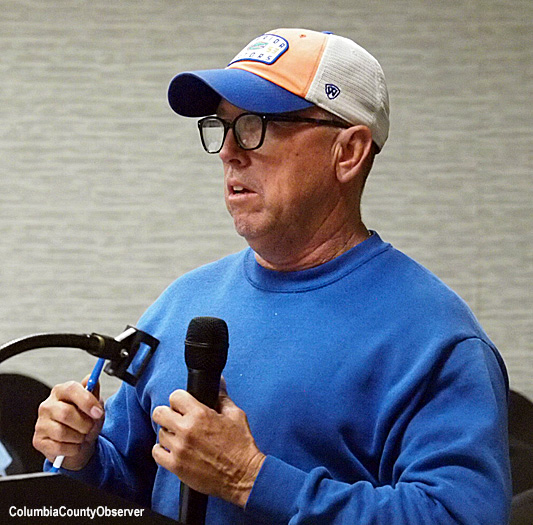
Ronnie Little didn't want to have to worry about what
was in his well water.
The last speaker of the evening was Ronnie Little. He told the Council, “When I talk about water, I talk about water I could drink, I can ingest, without worrying about what it may do to me, what it may do to my kids, my grandkids, future generations… I don't think cost should be what drives this… We should take the time and look at a better solution, put our heads together, and come up with a cleaner solution than this.”
Epilogue
The resolution against the WFNF project plan passed unanimously.
The Planning Council doesn’t believe in roll-call votes. It is unknown who was still attending virtually at the time of the vote. Roll call was not taken of those in attendance.