FHP Capt. Mike Burroughs Tells the NCFRPC, “Speed & Distracted Driving Kills" – He wants to keep you alive
May 1, 2026 11:30 pm | 5 min read
AI Summary
in a minute
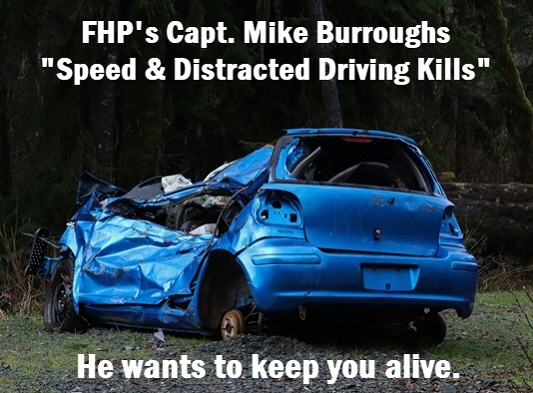
Photo: Izzy E via Unsplash
COLUMBIA COUNTY, FL – Captain Mike Burroughs, a 41-year veteran of the Florida Highway Patrol, spoke to the North Central Florida Regional Planning Council on April 23, emphasizing the downside – DEATH – of distracted driving and speeding.
Captain Burroughs, the Florida Highway Patrol’s most senior captain and District Commander of the Lake City District Office, overseeing Columbia, Hamilton, and Suwannee counties, urgently called on Council members from Alachua (the only non-RACEC county), Bradford, Columbia, Dixie, Gilchrist, Hamilton, Lafayette, Levy, Madison, Suwannee, Taylor, and Union to recognize and act on their unique power to save lives through bold, thoughtful roadway design decisions.
Speeding, and Crash Dynamics
Speed Kills
Captain Burroughs emphasized that major corridors in the region, I-75, I-10, U.S. 90, U.S. 441, U.S. 301, and other rural arteries, function as “high-speed corridors.” He said, drivers often treat interstates as if “nothing will be in their way,” but hazards such as tire debris, congestion, sudden stops, impaired drivers, fatigue, and distracted motorists make that assumption dangerous.
He said speeding is no longer unusual; when he joined FHP, catching someone over 100 mph was rare; now, he said, “it’s every day.” He described a “super speeder” problem and said drivers commonly exceed limits because modern vehicles make high speeds feel effortless: “In these new cars, it feels like you’re just coasting.”
Captain Burroughs repeatedly highlighted the lethal combination of speed and human error. “Roadways are designed for speed, yet drivers fail to adjust behavior,” he said.
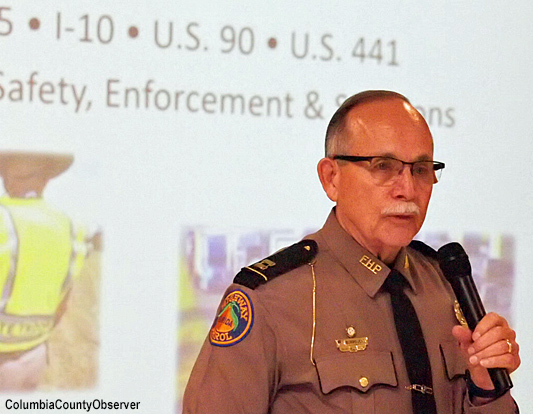
Capt. Burroughs addressed the elected officials, telling
them they can make a difference.
To explain the physics of speed, Capt. Burroughs passed an egg around the room, asking the audience to return it unbroken. He explained that at 70 mph, everything inside the vehicle — including internal organs — travels at 70 mph. At 80 mph, “you’re traveling 120 feet per second per second,” he said.
In a sudden stop or head-on collision, this kinetic energy can cause catastrophic results. Captain Burroughs put the egg in a jar and shook it, making a scrambled egg. Holding up the now scrambled egg, he described in detail the internal injuries a high-speed crash victim suffers:
“Your torso that houses all of your very important organs, heart, liver, lung, kidneys, spleen… is a sealed cavity… The first impact is most likely going to crack your rib cage, and it’s going to puncture an organ… That organ is going to begin to fill your body cavity with blood… Your lungs aren’t going to be able to expand, and as a result, you’re not going to be able to breathe.”
Rural Road Crashes
Captain Burroughs also tied speed to rural road crashes, explaining that drivers coming off interstates may continue at interstate-like speeds on two-lane rural roads; on those roads, a single yellow centerline is all that separates opposing traffic.
He warned that drivers place too much trust in that line: “We place so much trust in that yellow line,” even while tuning radios, checking phones, or otherwise driving distracted. When a vehicle leaves the lane, overcorrects, or crosses the centerline at high speed, the result can be catastrophic.
He noted that“some of the most grotesque scenes of fatalities that I’ve ever seen occur in North Florida on high-speed rural roads, where drivers lose control, overcorrect, and cause head-on collisions.” He noted that these incidents are almost entirely “behavior driven.”
He said Florida experiences approximately 390,000 crashes and over 3,000 fatal crashes annually, explaining that fatality or serious bodily injury crash costs counties $10,000 in emergency response, “burdening taxpayers and driving up insurance rates.”

Conditions can change in a moment. (Getty images)
Distracted Driving
Lane Departure Crashes
Captain Burroughs identified distracted driving as a pervasive, cross-generational epidemic tied to smartphone addiction.
He said distracted driving has evolved from older behaviors like reading newspapers or balancing checkbooks behind the wheel to modern cell phone and social media use. Today, he said, "It is common now to see a driver texting or at least engaging on social media, on their cell phone, driving with their knee and doing something with their driving hand.”
He linked distraction directly to lane departure crashes, which he said are increasing in Florida.
"Right now, in Florida, we are seeing a lot of lane departure crashes in the middle of the day – nice, beautiful sight visibility for as far as you can see, and for some reason, people are just running off the road, for no reason whatsoever...killing themselves."
He revealed troubling evidence from crash scenes:
“We are actually seeing cell phones that are playing TV shows that are inside the car that are still playing when we get there."
The Captain also noted other distractions: GPS screens, large in-vehicle displays, passengers, conversations, AirPods, music, and the overall “technical world” inside modern vehicles. Some screens, he said, are so large they are like “watching TV in your living room,” and their glare can impair night vision.
Fatigue, impairment, and compounding risks
Capt. Burroughs said fatigue is another major contributor, especially when combined with speed and distraction. He criticized the belief that people can sleep only a few hours, consume energy drinks, and still safely drive while scrolling social media. Energy drinks may temporarily delay sleepiness, but he warned of a “caffeine crash.”
Impairment compounds risks. Capt. Burroughs said fatal crash investigations now frequently involve combinations of alcohol, prescription drugs, and illegal drugs — not just alcohol alone. He described high alcohol levels and mixed substances contributing to drivers’ deaths and the deaths of others.
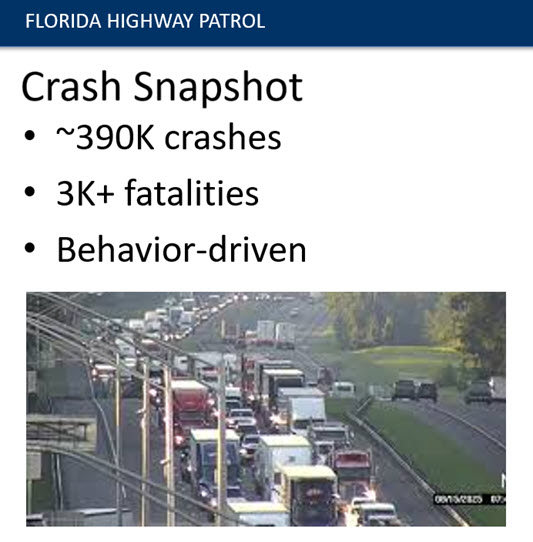
If these were statistics for airplanes, somebody would
have done something a long time ago. (FHP graphic)
Epilogue
When asked by your reporter, “Does the Florida Highway Patrol recommend speed limits? I ride down the interstate, and everybody's doing 80. Does the Florida Highway Patrol recommend speed limits to slow people down?”
Captain Burroughs answered, “Yes, sir, that's what we do. Slow 'em down. Yes, sir.”
On March 11, 2026, the Florida House passed Senate Bill 1220, which, by a last-minute amendment, proposed raising the speed limit to 80 mph.
The Florida Senate did not agree, and the bill stalled out.
It is unknown if the Florida Highway Patrol had anything to do with it.