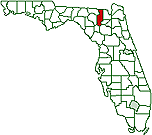
Fort White Recall: Circuit Court Judge Fred Koberlein, Jr., Put the Brakes on the Fort White Recall Election – For Now
It’s now up to the Fort White Mayor’s brother to decide whether or not to soldier on.
April 15, 2026 9:20 pm | 5 min read
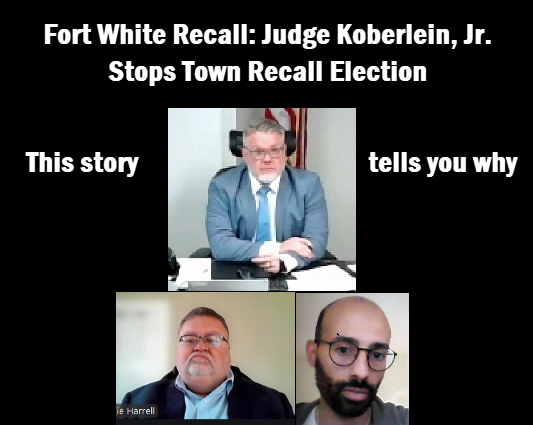
Judge Fred Koberlein, Jr., center; Councilman Harrell
(bottom left); Defendant Giorgio Thomas, (right).
Photos via Columbia County Court Administration Zoom
hearing.
FORT WHITE, FL – Circuit Court Judge Fred Koberlein, Jr., ruled from the bench late Monday afternoon that the recall election scheduled in Fort White for the next day (April 15) was not going to happen.
While the campaign to recall Fort White Town Councilman Lonnie Harrell ground to a halt, the Recall Committee, via Chairman Giorgio Thomas, the brother of Mayor George Thomas, will need to decide by 5 pm Friday afternoon whether or not he wants to move forward with the recall of Councilman Harrell.
The defendants, Mr. Thomas, Ms. Cook, and the Supervisor of Elections, have until Friday to decide whether to soldier on or withdraw.
At the conclusion of Monday’s hearing, Judge Koberlein explained the next step: “The court does grant that part of the amended, verified motion for emergency injunction, and does require the plaintiff's counsel [council for Councilman Harrell – ed.] to confer with the other defendants and determine the necessity of a trial, and should a trial be necessary, to ascertain the amount of time necessary to provide all interested parties positions and set the matter for a Case Management Conference on this Court's docket so that a trial date may be set."
In the Zoom Room on Monday Afternoon
Monday’s (Zoom) hearing, in order of appearance
Councilman Lonnie Harrell’s (plaintiff) case against the recall
Councilman Harrell is represented by Morgan Bentley of Sarasota, FL.
Mr. Bentley's central argument is that the recall petition is "facially insufficient" because it contains several legally flawed allegations. He cites Florida Supreme Court case law, primarily Garvin v. Jerome, which establishes that if even one allegation in a recall petition is legally insufficient, the entire petition must be invalidated.
Mr. Bentley dissected the allegations against Councilman Harrell, arguing that they are based on opinions, disagreements on votes taken during public meetings, and vague accusations, rather than the legally required grounds of malfeasance, misfeasance, or neglect of duty. He asserted that case law forbids recalling an elected official for their votes or for statements deemed "a bad reflection" on the town, as these are part of the normal political process.
Mr. Bentley, referencing a recent Nassau County recall case, told the court:
"Absent injunctive relief. There is no judgment the plaintiffs can obtain in a proceeding of law… simply, there's no available legal claim that can remedy the improper forcing of plaintiffs to endure a recall process regardless of the outcome of the vote, as well as the possible loss of rights."
Judge Koberlein invites Giorgio Thomas, Recall Chairman, to present his case
Recall Committee Chairman Giorgio Thomas appeared as a defendant (pro se) and argued the court should deny the injunction and allow the election to proceed. His core argument rested on the four elements required for injunctive relief under Florida law: a substantial likelihood of success on the merits, irreparable harm, a lack of an adequate legal remedy, and the public interest.
Mr. Thomas told the court that Mr. Harrell failed “to satisfy the four essential elements required for injunctive relief under Florida law."
Defendant Giorgio Thomas told the court:
"Mr. Harrell’s delay created a false emergency."
Mr. Thomas argued that post-election legal remedies existed and that Mr. Harrell’s delay created a false emergency. He said the public interest favored the election (supported by signatures from about half the district's voters). Mr. Thomas said that the court could invalidate the election, a remedy Mr. Harrell acknowledged in his request for injunctive relief.
See the Garvin v Jerome FL Supreme Court Case here.
Judge Lewis' dissent begins at the bottom of page nine of the opinion. The dissent reflects Mr. Thomas' argument against delaying the recall election.
Judge Koberlein pushed back on Mr. Thomas's use of the FL Supreme’s Garvin v. Jerome decision, pointing out that the Supreme Court in Garvin actually adopted the standard (citations omitted), where a petition with even one legally insufficient ground could fail entirely.
Mr. Thomas conceded the point.
Mr. Thomas concluded by arguing that – the benefits of proceeding with the election ensured voter accountability, preserved due process, and avoided the waste of public resources – outweighed plaintiff Harrell’s concerns.
Defendant Tomi Brown, Supervisor of Elections
Tomi Brown, Columbia County’s Supervisor of Elections, was represented by County Attorney Joel Foreman, Florida’s only popularly elected county attorney. Judge Koberlein introduced Mr. Foreman to the Court and asked whether he wished to be heard.
He did, arguing that Supervisor Brown is an"indispensable party" to the action because any injunctive relief ordering a halt to the election would directly require her, as Supervisor of Elections, to stop conducting it.
Mr. Forman sided with plaintiff Harrell’s request to block the recall election.
Mr. Foreman quoted the Florida Supreme’s language in Garvin, which refused to permit the recall of a duly elected official on grounds determined to be "invalid under the statutory scheme," calling such an outcome a "clear violation" of the statutes limiting grounds for recall.
Judge Koberlein interjected, “You brought up the Garvin’s decision, which is a dispositive decision. Today, the court, based on Mr. Harrell's request, is making a preliminary decision. Mr. Thomas has pointed out in his written response that Mr. Harrell's actions, or lack of actions, as Mr. Thomas would put it, have caused us to be here at a preliminary as opposed to a final hearing the night before a recall process.”
Mr. Foreman responded, “Yes, sir, Your Honor. And I think that was the point of the dissent in Garvin: expediency and timeliness should be a factor. And certainly, that's why I'm here, Your Honor, so I can let the supervisor know as soon as the court makes a decision, which certainly would have been preferential to have additional time.”
Judge Koberlein Concludes the Hearing: Final Remarks
Judge Koberlein ruled from the bench. (actually, the desk in his conference room)
Judge Koberlein stated that after reviewing the arguments and case law, the court finds a "substantial likelihood of success on the merits" for the plaintiff's complaint.
He said that allowing the election to proceed would cause "irreparable harm" and that there is a "lack of a remedy at law." He emphasized that the goal is to protect not only the plaintiff but also the constituents and the "integrity of the election system."
The long story short, Judge Koberlein granted Councilman Harrell’s request for emergency relief and canceled the recall election – for now.
Following his ruling, Judge Koberlein instructed Mr. Harrell’s counsel to write the court’s order and confer with the defendants about the necessity of a trial.
The defendants, Mr. Thomas, Ms. Cook, and the Supervisor of Elections, have until Friday to decide whether to soldier on or withdraw.